Pinocchio reunites with the Fairy on Busy Bee Island
The Adventures of PinocchioPinocchio reunites with the Fairy on Busy Bee Island after a night of desperate swimming and a day in which hunger exposes how far his pride still stands between him and help. The reunion is both recognition and a turning point: the woman who feeds him is the Fairy with Azure Hair, and their renewed bond leads Pinocchio to promise that he will study and work in order to become a real boy.
Arrival and Need
Driven by hope of finding Geppetto and reaching him in time to save him, Pinocchio swims all night. Rain, hail, thunder, and lightning make the crossing perilous; at dawn, he sees a stretch of sand and reaches an island. After leaving the shore, he walks for half an hour before coming to a busy settlement. Its streets are full of people going about their tasks. Everyone appears occupied, and Pinocchio sees no idle man or tramp. The contrast between this working community and his own reluctance is immediate: he decides that the place is not for him because he was not born to work.
Hunger soon makes that refusal harder to maintain. Pinocchio has gone twenty-four hours without eating, and he recognizes that his remaining options are to work or beg. He feels ashamed to beg, remembering Geppetto’s teaching that begging should be reserved for people whose age or illness prevents them from earning their bread. That principle gives him a reason to reject begging, but it does not yet make him willing to labor.
Pride Tested by Work
A coal worker passes, struggling to pull two heavy carts. Pinocchio asks him for a penny because he is faint with hunger. The man offers not just one penny but four if Pinocchio will help pull the carts. Pinocchio is offended by the proposal and protests that he has never been a donkey or pulled a wagon. His response turns an ordinary offer of paid work into a test of dignity as he understands it: he would rather remain hungry than accept a task he associates with a beast of burden.
A second opportunity comes through a woman carrying jugs. She offers him bread if he will help carry them home. Pinocchio hesitates rather than agreeing at once. When the prospect of additional food is raised—bread, cauliflower, and cake—he finally accepts. The jug is too heavy for him to carry in his hands, so he balances it on his head and takes it to her home. The scene makes the change in his conduct concrete and modest: hunger does not suddenly make him eager for work, but it moves him from refusal to completing a useful task.
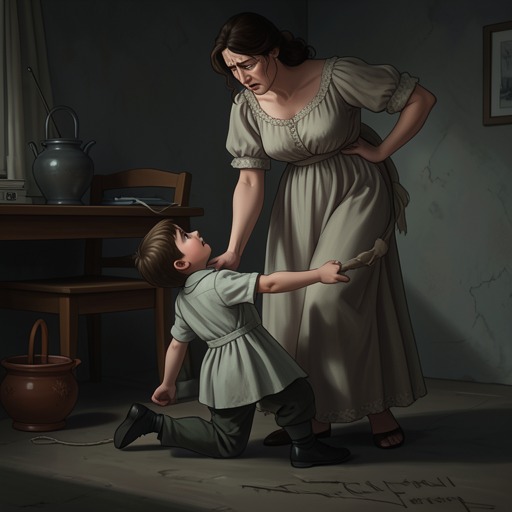
The woman gives him the promised food, and Pinocchio eats with an urgency that suggests how severe his hunger has become. Only after he has finished does he look closely at his benefactress. Her voice, eyes, and azure hair recall someone he loves. The meal’s ordinary domestic setting gives way to recognition: he stammers out that she resembles the Fairy, then throws himself to the floor and clasps her knees, expressing how much he has cried and suffered.
Recognition and Reunion
The woman first responds with laughter, but she soon admits that she is indeed the Fairy with Azure Hair. Pinocchio recognizes her through the likeness of her voice, eyes, and hair; she confirms what his recognition has already made emotionally certain. His response makes the reunion more than a discovery of identity. He embraces her knees, overcome by the return of someone he thought lost, while she receives his distress with affectionate amusement rather than distance.
The reunion follows a sequence of dependence and reciprocal kindness. Pinocchio arrives hungry, rejects one offer because it wounds his pride, and accepts another when the labor is paired with food. The Fairy’s kindness is not simply a gift detached from his conduct: he carries the heavy jug before receiving the meal. At the same time, the episode does not present his work as proof that he has already reformed. His reluctant bargaining and earlier rejection remain part of the scene, making the small task a first step rather than a completed transformation.
A Promise of Reform
After revealing herself, the Fairy asks Pinocchio whether he will always obey her and do as she wishes. He agrees readily. She tells him that, beginning the next day, he will go to school every day. The prospect gives him pause, and she also says he will choose the trade he likes best. Her instructions connect education and future work to the practical labor he has just resisted.
When Pinocchio says that work tires him, the Fairy warns that people who speak that way may end in prison or a hospital. She argues that everyone, rich or poor, must do something in the world and that happiness cannot be found without work; she describes laziness as an illness that must be cured from childhood. These words touch him. He solemnly promises to work, study, and do as she tells him, explaining that he has grown tired of life as a Marionette and wants to become a boy, however difficult that may be. The Fairy promises that this is possible, but leaves its realization up to him.
The episode thus joins reunion to a practical moral test. Pinocchio’s longing for the Fairy is answered, but affection does not remove the demands she sets before him. The all-night swim began with the hope of saving Geppetto; the return of the Fairy redirects Pinocchio toward school, labor, and self-discipline. His promise is not yet its fulfillment, but the scene marks a clear change in intention: the wish to become a real boy is now attached to concrete duties he has agreed to undertake.